
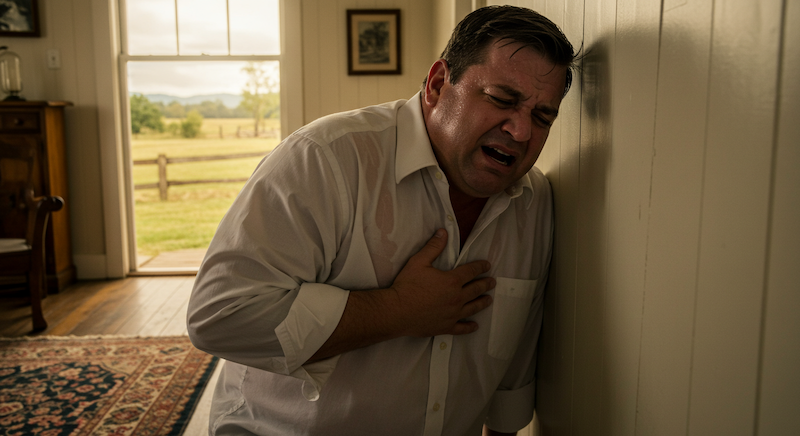
Back in 1975, my parents bought and fixed up an old farmhouse. Twenty-some years later, they decided to replace the carpet. After working the night shift, I decided to stop at the farm to see how it looked. I noticed the flooring van as I parked, so when I walked into the house, I was expecting to see some new carpet, but I did not.
What I did see was one man, a big man, leaning against the living room wall, drenched in sweat. I said good morning to him, told him who I was, and began to look around the room. I saw the new carpet roll plus all the tools this man needed for installation and concluded that he was sweating and resting because he had carried all of those things in by himself on this warm and humid morning. I asked him if he wanted some water, but he shook his head no. So, I went into the kitchen to see if there were any good homemade Mom snacks.
After a short snack, I walked back into the living room only to see this guy still leaning against the wall and still profusely sweating. I now realized something could be wrong, so I asked, “What’s going on with you?” “I don’t know, I’m dizzy and my arm hurts,” was his reply.
Recognizing the Signs of Heart Attack
Before this event, I recently took a class in First Aid and CPR. It was my first time certified, and I knew these signs were not good. Now, less than a month from my completion date, I was face to face with a potential heart attack victim. I began explaining about my training and told him these warning signs were not good and that we should be calling 911.
That was a mistake on my part, as it just opened him up to his opinion. He instantly began to contest my decision. “Just give me some water and let’s wait about twenty minutes to see if this stops,” was his statement. I got the water, but my training was now fresh in my mind, and I knew I had to act.
“Listen,” I said, “I’m not a doctor, and I don’t know what’s wrong with you, but I do know these warning signs are not good, and you really need some medical attention right now.” I pleaded. He still didn’t want any part of that and began talking about all he had to do that day. He was firm in his resistance and made it clear he didn’t want any part of a hospital visit.
I turned the tables on him and closed this deal by saying this, “If I am right about what I think is wrong, the next thing that is going to happen to you is, you are going to go down, and if that happens, then I will have to call 911. Then, I have to start pushing really hard on your chest, and after thirty times of doing that, I will have to put my mouth on your mouth.” I concluded in a raised voice.
He gave me a funny look, shook his head, and said, “Call ‘em.”
Related Article: Why is Learning CPR & CPR Certification Important?
The Hospital and the Aftermath
Fortunately, he stayed conscious on the trip, and in the emergency room, the doctors quickly found the problem and informed him that he had some blockage and was experiencing a heart attack. They went forward with a procedure. Not sure what they did, stent or balloon or something like that, but whatever it was, they fixed it before he went into cardiac arrest.
Why the Resistance?
So, why was he so resistant to get medical help? Those of you that have read my articles in the past know I like data concluded by professionals and use that data to express a problem, then I like to produce solutions. I am not doing that today. What I am about to say has no scientific proof, but instead, I am drawing my own conclusions generated by sixty-five years on this planet. You can agree or disagree, but, in my life, men are the worst when it comes to making the decision to go to the doctor.
They can have severe indigestion and blame it on a sandwich they ate three days ago. I had a good friend take about a four-inch swath out of the top of his foot, the width of a chainsaw. Know why? He hit the top of his foot with a chainsaw! He fixed that with ten-pound Trilene fishing line and a sewing needle as opposed to going to the doctor for stitches. My grandfather, (who was diabetic), actually cut off his own little toe to avoid the expense of having a doctor do it. He said that he couldn’t feel anything anyway, so he did it himself. I have many more man stories here, but we are going to stop, and I am concluding that men can be a real pain in these instances, especially when heart attack symptoms appear.
Recognizing Heart Attack Symptoms
To take the argument away from the men, you should first memorize the symptoms of a heart attack. Chest pain is the primary sign and most everyone, (including the men) will understand this one. It is all the other symptoms that can cause controversy and create resistance. Here they are: sweaty, dizzy, nausea, vomiting, shortness of breath, pain in the arm, shoulder, or back, rapid pulse, unexplained fatigue, and indigestion. All of these can be a sign of a heart attack. These symptoms can be singular or, like the guy at the farmhouse, multiple.
If you recognize any of these symptoms, call 911 and keep the person calm and rested. Do not be afraid of being wrong. It is truly for the doctors to figure out. They will run an EKG on the person, and if there is blockage, they typically can fix it. If you have to call 911 in front of a victim, just state the symptoms. Example: “I have a 63-year-old man that is dizzy with pain in their arm and is sweating.” What you never say aloud in front of a victim is “heart attack.” They do not need to hear that even if they are suspecting it themselves.
Recognizing the symptoms and making the call is the most important thing you can do in case of a suspected heart attack, as time is not on their side. Don’t get caught up in a discussion like I did with my first heart attack victim, and, if it is a man, expect some resistance, but make the call anyway and let them argue it out with the professionals after they show up.



0 Comments